Clustering in mean-field transformer models

Emergence of meta-stable clustering in mean-field transformer models

ICLR 2025 [Oral]

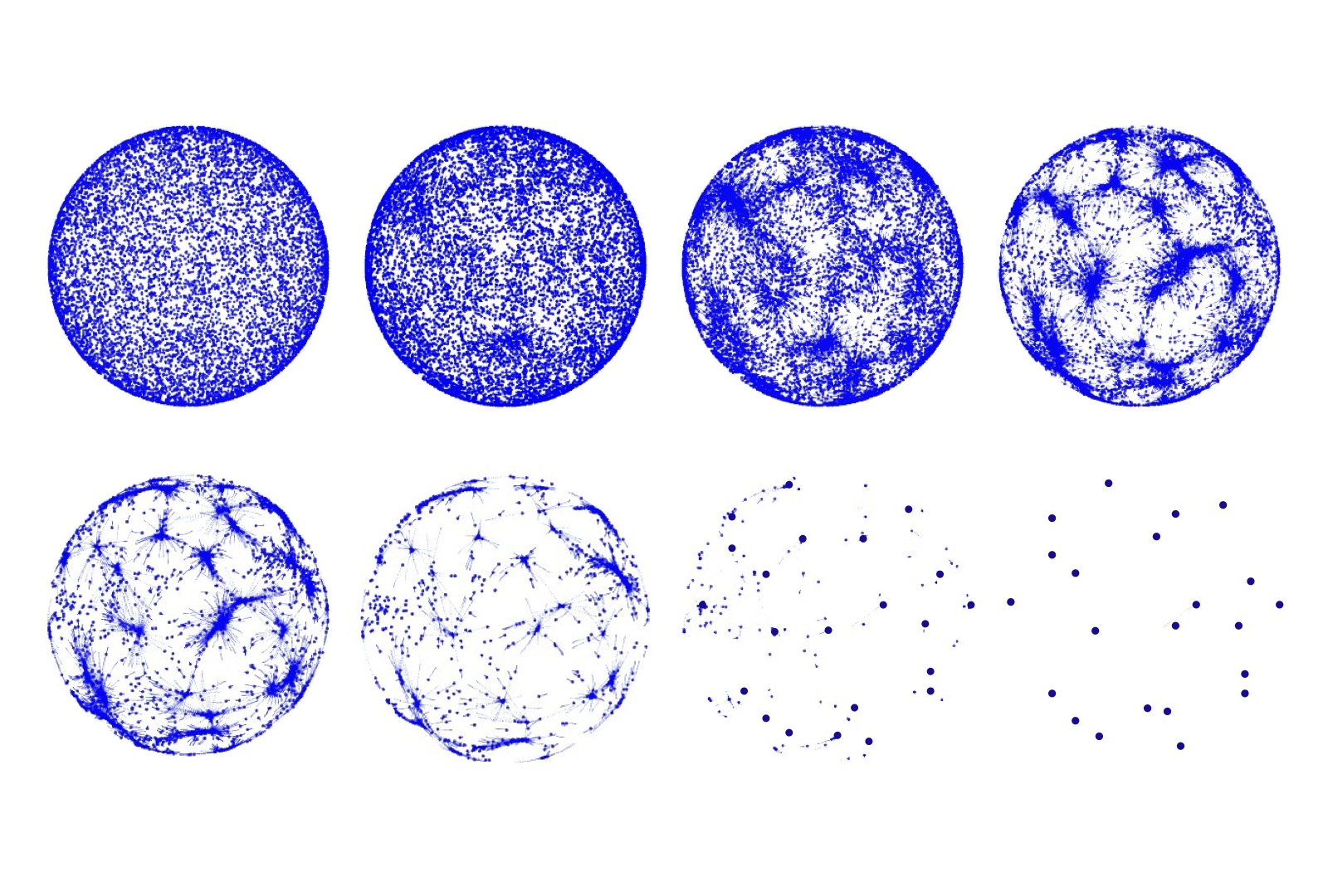
We model the evolution of tokens within a deep stack of Transformer layers as a continuous-time flow on the unit sphere, governed by a mean-field interacting particle system, building on the framework introduced in (Geshkovski et al., 2023). Studying the corresponding mean-field Partial Differential Equation (PDE), which can be interpreted as a Wasserstein gradient flow, in this paper we provide a mathematical investigation of the long-term behavior of this system, with a particular focus on the emergence and persistence of meta-stable phases and clustering phenomena, key elements in applications like next-token prediction. More specifically, we perform a perturbative analysis of the mean-field PDE around the iid uniform initialization and prove that, in the limit of large number of tokens, the model remains close to a meta-stable manifold of solutions with a given structure (e.g., periodicity). Further, the structure characterizing the meta-stable manifold is explicitly identified, as a function of the inverse temperature parameter of the model, by the index maximizing a certain rescaling of Gegenbauer polynomials.
May 15150 · Giuseppe Bruno, Federico Pasqualotto, Andrea Agazzi
Navier Stokes equations

The Challenges of the Nonlinear Regime for Physics-Informed Neural Networks

NeurIPS 2024 [Poster]

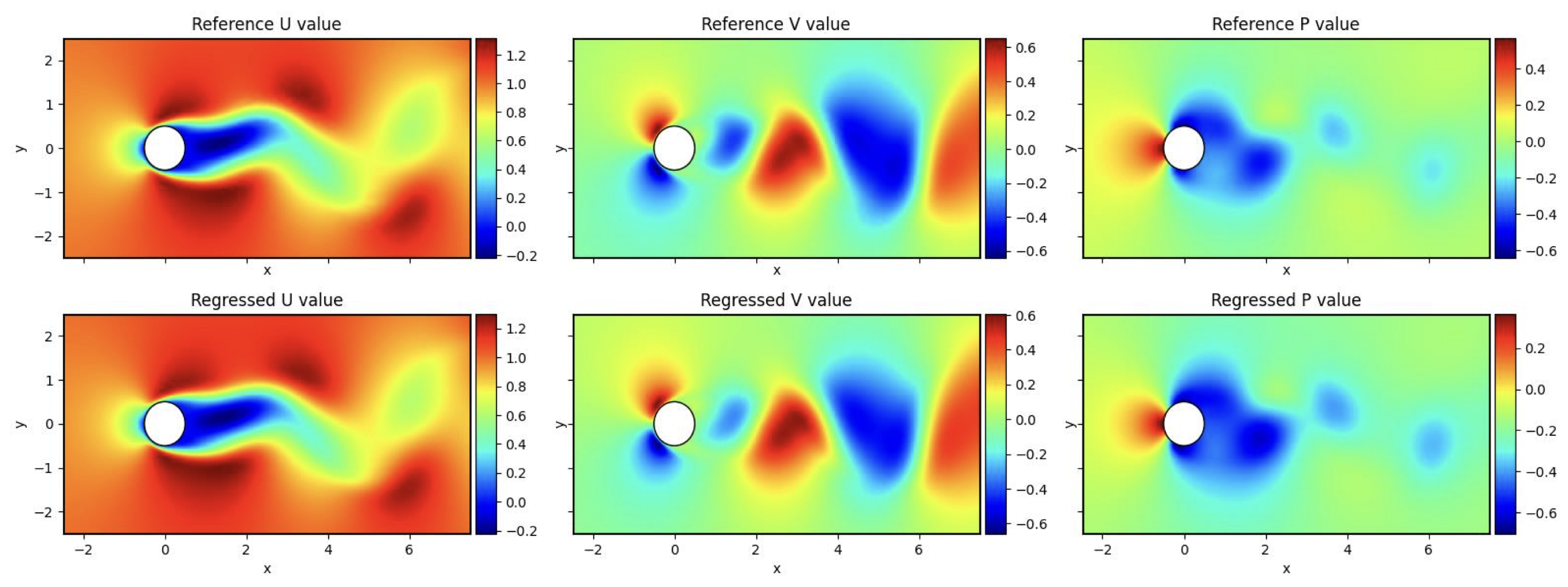
The Neural Tangent Kernel (NTK) viewpoint is widely employed to analyze the training dynamics of overparameterized Physics-Informed Neural Networks (PINNs). However, unlike the case of linear Partial Differential Equations (PDEs), we show how the NTK perspective falls short in the nonlinear scenario. Specifically, we establish that the NTK yields a random matrix at initialization that is not constant during training, contrary to conventional belief. Another significant difference from the linear regime is that, even in the idealistic infinite-width limit, the Hessian does not vanish and hence it cannot be disregarded during training. This motivates the adoption of second-order optimization methods. We explore the convergence guarantees of such methods in both linear and nonlinear cases, addressing challenges such as spectral bias and slow convergence. Every theoretical result is supported by numerical examples with both linear and nonlinear PDEs, and we highlight the benefits of second-order methods in benchmark test cases.

May 28280 · Andrea Bonfanti, Giuseppe Bruno, Cristina Cipriani